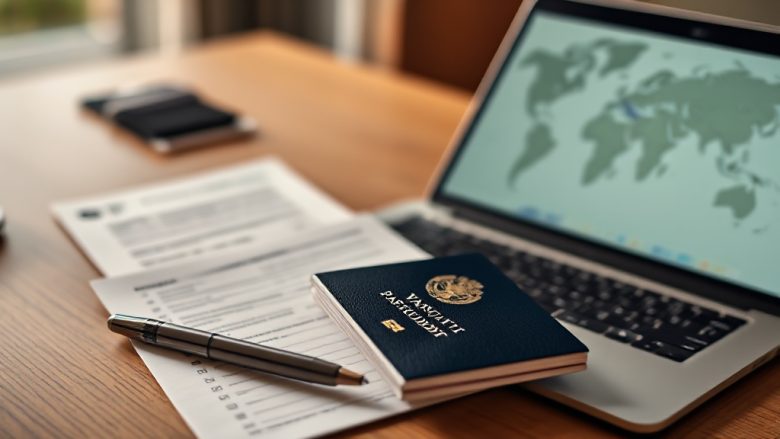
A Day Inside the Vanuatu Passport Process
The coffee had gone cold an hour ago. On the desk, a scanned copy of a birth certificate sat open beside a checklist that had already been annotated twice, once in blue ink and once in pencil. It was 9:40 on a Tuesday morning, and the day had barely started, yet the paperwork was already in motion. Anyone who has spent time inside the Vanuatu passport process knows this rhythm: long stretches of quiet document work, punctuated by short bursts of correspondence with an agent, a bank, or a translator. The official website for the process had been open in a browser tab for days, not because it was difficult to read, but because the details kept revealing themselves in layers.
This is not a story about a dramatic decision. It is a story about a Tuesday, and the small, unglamorous tasks that make up a citizenship-by-investment application when it is lived rather than researched.
Morning: The Quiet Work of Documents
By 10:15, the day’s first real task was underway: reconciling names across three documents. A passport, a marriage certificate, and a bank statement each spelled the applicant’s middle name slightly differently. None of the differences were dramatic, but in the context of a government submission, they mattered. The designated agent had explained this early on, and the explanation had been repeated on the official website: applications are not filed directly with the Citizenship Commission. Everything moves through an authorised representative, which means the quality of the file is filtered through a professional eye before it ever reaches a desk in Port Vila.
That filtering changes the texture of the work. It is not a matter of filling in a form and hoping for the best. It is a matter of anticipating what a reviewer will notice. The morning was spent drafting a short statutory declaration explaining the name variation, then emailing a notary to confirm an appointment for the following week. By the time the reply arrived, it was nearly noon, and the checklist had acquired a new line item.
What stands out in these hours is how little of the process is about money, at least in the moment. The investment threshold is real and significant, but on an ordinary day, the work is almost entirely administrative. It is signatures, seals, translations, and courier tracking numbers. The financial side is a series of confirmations; the document side is a series of small negotiations with reality.
Afternoon: Calls, Confirmations, and the Shape of the Timeline
The afternoon began with a scheduled call to the agent. These calls tend to follow a pattern: a review of what has been submitted, a review of what is still outstanding, and a revised sense of timing. The timeline for a Vanuatu passport is often described in months, but lived in weeks. Each week has its own micro-deadline, and each micro-deadline has a dependency. A police clearance cannot be requested until a fingerprint card is completed. A fingerprint card cannot be completed until an appointment is booked. An appointment cannot be booked until a specific form is printed and signed.
This is where the process becomes almost meditative. There is no way to rush it, only a way to sequence it correctly. The agent’s role is to keep the sequence intact. The applicant’s role is to keep the documents moving. On this particular afternoon, the call lasted twenty-two minutes and produced three action items: a certified copy of a utility bill, a refreshed bank reference letter, and a confirmation that the source-of-funds narrative matched the figures already submitted.
Between calls, there was time to read. The official website had a section on visa-free travel that was worth revisiting, not because the list changes daily, but because it changes the way the whole exercise feels. A passport is not just a document; it is a set of permissions. Seeing the countries laid out in a list turns an abstract investment into a concrete itinerary. For a few minutes, the paperwork faded and the purpose returned.
Late Afternoon: The Emotional Texture of Waiting
By four o’clock, the day had shifted from doing to waiting. This is the part of the process that rarely appears in summaries. Waiting is not passive; it is a low-grade hum of attention. A courier might arrive. An email might request a clarification. A bank might need a phone call. The applicant learns to keep the file within arm’s reach, physically and mentally.
There is also a quieter emotion that surfaces in these hours: the awareness that this is a significant commitment. Citizenship by investment is not a transaction in the ordinary sense. It is a legal change of status, and it carries responsibilities as well as benefits. The afternoon’s waiting was interrupted by a short review of the oath and affirmation language, which had been provided by the agent. Reading it slowly, rather than skimming it, changed its weight. It was no longer a formality; it was a statement.
Around five, a confirmation arrived: the police clearance application had been received by the relevant authority. It was a small win, the kind that does not feel like a win until it is listed on the checklist. The pencil came out again, and one line was struck through.
Evening: Reflection on What the Process Actually Asks
By evening, the desk was tidier. The documents had been sorted into a folder, the folder into a courier envelope, and the envelope placed by the door. The laptop remained open, but the browser had been reduced to two tabs: the agent’s portal and the official website. The rest had been closed, which felt like a small act of closure.
Reflecting on the day, what stands out is how much of the Vanuatu passport process is about attention rather than effort. The requirements are not mysterious; they are published, and they are explained. The challenge is consistency. A single mismatched date, a missing apostrophe in a name, an expired certification, and the file pauses. The process rewards people who can hold details steady over weeks, not people who can move quickly.
It also rewards people who ask questions early. The agent had been clear about this from the first conversation: nothing is too small to confirm. The official website had reinforced the same message, not with warnings, but with structure. Steps, forms, fees, requirements, and timelines were laid out in a way that made the process legible, even when it was not yet easy.
There is a version of this story that focuses only on the destination: a passport, a set of visa-free destinations, a second citizenship. That version is true, but it skips the middle. The middle is where the day actually happens. It is a Tuesday of name variations and notary appointments, of calls and confirmations, of waiting and small wins. It is not dramatic, but it is real, and it is the part that most people only understand once they are inside it.
By the time the folder was placed by the door, the day had done its work. One more set of documents was ready to move. One more week of the timeline had been accounted for. And somewhere in the background, the process continued, quiet and steady, the way it always does.